
Urgent beats important
Everything on fire has a person attached to it. The big thing has nobody asking. So it loses, quietly, every single week.
PlanExecuteWin
Founding cohort · Opens September 2026
Another busy week just ended. The needle didn't move.
GSD is a 90-day execution and accountability group for business owners who know what they need to do — but keep letting everything else get in the way.
Choose one important business goal. We'll help you turn it into a clear 90-day plan, track it in your private dashboard, and keep it moving with a small group that meets every Tuesday to report progress, solve what's stuck, and decide what happens next.
Not a course. Not a hype room. A working room built around actually getting the thing done.
You already know what to do. Great. That saves us a lot of time.
Enrollment closes Sunday, September 13 · 12 VIP spots
Get.
Sh!t.
Done!
The GSD promise
Clarity → concrete action.
Motivation. Accountability. Connection.
Thirty-five years of building and operating between us · Two facilitators, small pods
The reactive week
You know what the important thing is. You wrote it down in January. Then Monday arrived with a client emergency, a payroll question, forty-one unread emails, and apparently everyone in the world needing something from you at the exact same time.
So the important thing waited. Again.
Not because you're lazy or unclear, but because nothing in your week is built to protect it.
Everything on fire has a person attached to it. The big thing has nobody asking. So it loses, quietly, every single week.
It's in a notebook, 50 sticky notes across your desk, and your head. A plan in three places is a plan you never open. You can't be held to what you can't see.
You're the owner. There's no boss, no board, no Friday check-in. The only accountability in your business is the kind you invent, and it's the first thing you drop.
How GSD started
We didn't sit down and decide to build a mastermind. We were trying to get our own shit done. Apparently we accidentally built one.
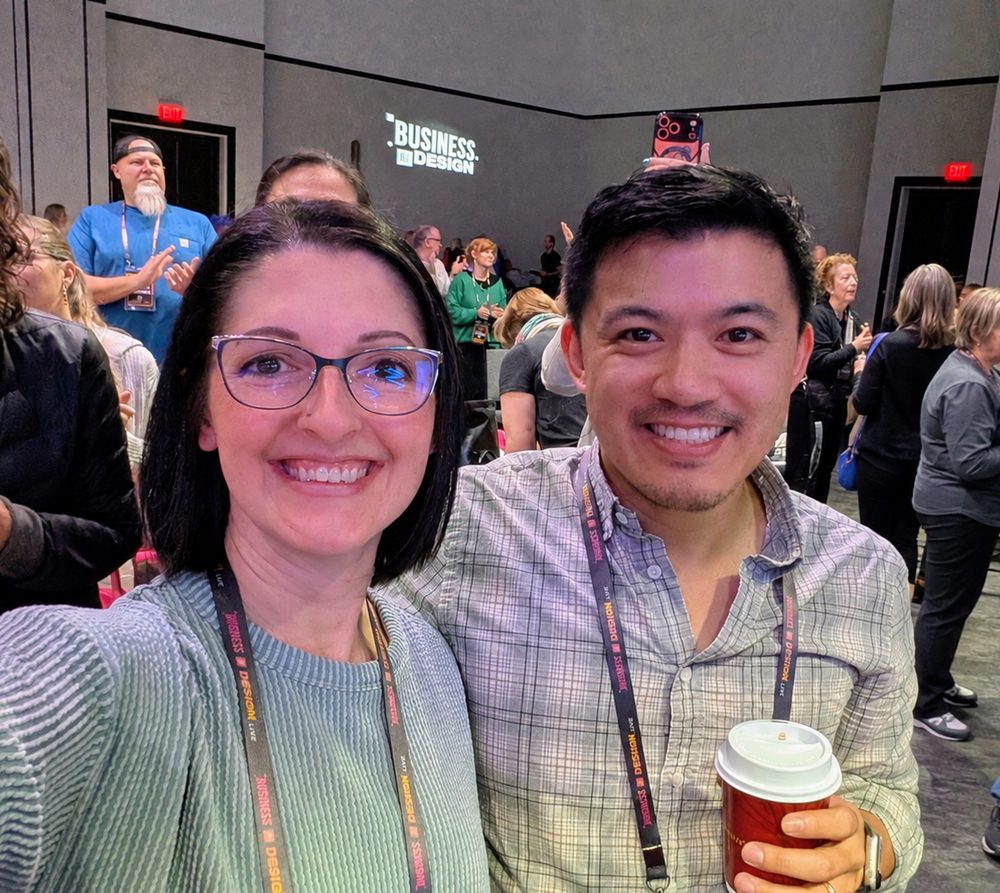
We met in a room full of ambitious business owners, all of us nodding at the same slides. Same trainings, same frameworks, same problem: everyone left inspired, and nobody left accountable. Aaron was building a consulting firm. Heidi was building her fourth business in twenty years. Different companies, identical bottleneck, and neither of us wanted to be the first to admit it.
So we started calling each other. Once a week, no agenda beyond one question: what did you say you'd do, and did you do it? No slides. No breakout rooms. Just a recurring calendar invite that turned out to be harder to ignore than a client deadline.
We called it an accountability club, which made it sound far more official than two people trying not to disappoint each other. Within a couple of months we'd both moved things that had been stuck for over a year. Not because we'd learned anything new. Because someone was going to ask on Thursday, and neither of us wanted to be the one with nothing to report.
Then people started asking to join.
Not many. A few, one at a time, all of them capable operators with the same quiet complaint: I know exactly what to do. I'm just not doing it. That's when we stopped calling it a club and built it properly. A planning session. A weekly rhythm. A dashboard. A room with a door on it.
And we gave it the name we'd been using in our texts the whole time, because it was the only thing it was ever about.
The name
Get Shit
Done.
Not a slogan somebody workshopped. Not the result of a three-day brand intensive. It's literally what we kept saying to each other, and it turned out to be the whole strategy. Eventually we figured we should probably put it on the website.
Why now
The two-person version worked, and it doesn't scale past two people. Ten is the size where you get real accountability and still know everyone's business by name. So that's the pod, and the cohort is built out of them. This is the first time we've run it at this scale, which is exactly why it's priced as a founding cohort.
Warm high
performance.
The four lies
You've told yourself all four. Don't worry, we have too. Each one sounds responsible, and each one buys you another quarter of no movement. Unfortunately, they're still bullshit.
The Focus Lie
"I just need to focus harder."
Discipline isn't your problem. You built something real, which took more discipline than most people will ever spend. The problem is structural. A reactive week beats a focused person every time, because the week has deadlines with other people attached and your priority doesn't. GSD gives your priority a deadline with a person attached. Nine of them, every Tuesday, and they will notice.
The Hype Lie
"Masterminds are expensive cheerleading."
A lot of them are. You pay four figures to sit in a Zoom grid while someone with a ring light tells you to think bigger, and nothing in your business is different ninety days later. Same Zoom, opposite format: nobody attends a GSD call, everybody reports on one. Every session opens with what you committed to and whether it happened. Encouragement is free here. Follow-through is the product. There will be no motivational yelling. Okay, Heidi might get excited if you actually finish the thing, but you'll have earned it.
The Self-Reliance Lie
"If I really wanted it, I'd hold myself to it."
Every high performer you admire is surrounded by structure they didn't build alone. Boards, coaches, co-founders, partners. Wanting it has never been the variable. Being watched by people whose opinion you care about is. That's not a character flaw to fix. It's a condition to arrange.
The Content Lie
"I already know what to do."
You probably do. You've bought the course, saved the frameworks, downloaded the PDF, and can explain the strategy better than the person who sold it to you. You may even have a beautifully organized folder for all of it. Look at you being productive. You don't have an information gap. You have an execution gap. GSD has no video library, no modules, and no homework. It has a plan you write, a week you report on, and a room that asks again next Tuesday, and the Tuesday after that.
The shift
You do not need a new morning routine, a personality transplant, or another color-coded planner. Nothing here requires you to become a more disciplined person. It requires you to stop running a business where nobody is expecting an answer.
On your own · today
In the room · with GSD
A course sells you information you don't have.
GSD gives you the follow-through you don't have.
Not alone. Not stuck.
Moving forward.
Who runs it
Two business owners, coaches, and strategists who built the room we wanted to be in ourselves. We overlap on purpose. We both coach, challenge, problem-solve, and help people turn ideas into action. And we notice different things, ask different questions, and bring different perspectives to the same goal.
Aaron will help you make the plan make sense. Heidi will probably ask the question you were hoping nobody would ask. And because neither of us stays neatly in our own lane, sometimes Heidi will fix the strategy and Aaron will call you on your bullshit.
That's kind of the point.

Co-Founder + Coach
Aaron has spent 15+ years helping ambitious plans survive contact with reality — inside large organizations, as a consultant, and now as a business owner himself. He brings a sharp eye for priorities, systems, execution, and the places where a good plan starts getting unnecessarily complicated.
He's also an experienced coach who knows that the right strategy means very little if it doesn't work for the person responsible for carrying it out. Aaron will help you sharpen the plan, challenge the assumptions underneath it, and turn a fuzzy goal into something you can actually move. He also helps businesses use AI to do more with less.

Co-Founder + Coach
Heidi has spent more than two decades building and running her own companies, across e-commerce, membership communities, photography, and coaching. She's built the offer, the brand, the client experience, and the operations behind all of them, which means she's had every conversation a GSD member is about to have.
She understands what it's like to have something successful already demanding your attention while another idea keeps asking to be built.
She'll cut through the noise, name what's actually keeping you stuck, and push the plan until it's something you'll really do. She asks the question you've been avoiding, and she does it early enough to matter.
Different lenses. Shared standards.
One room built to help you move.
The room
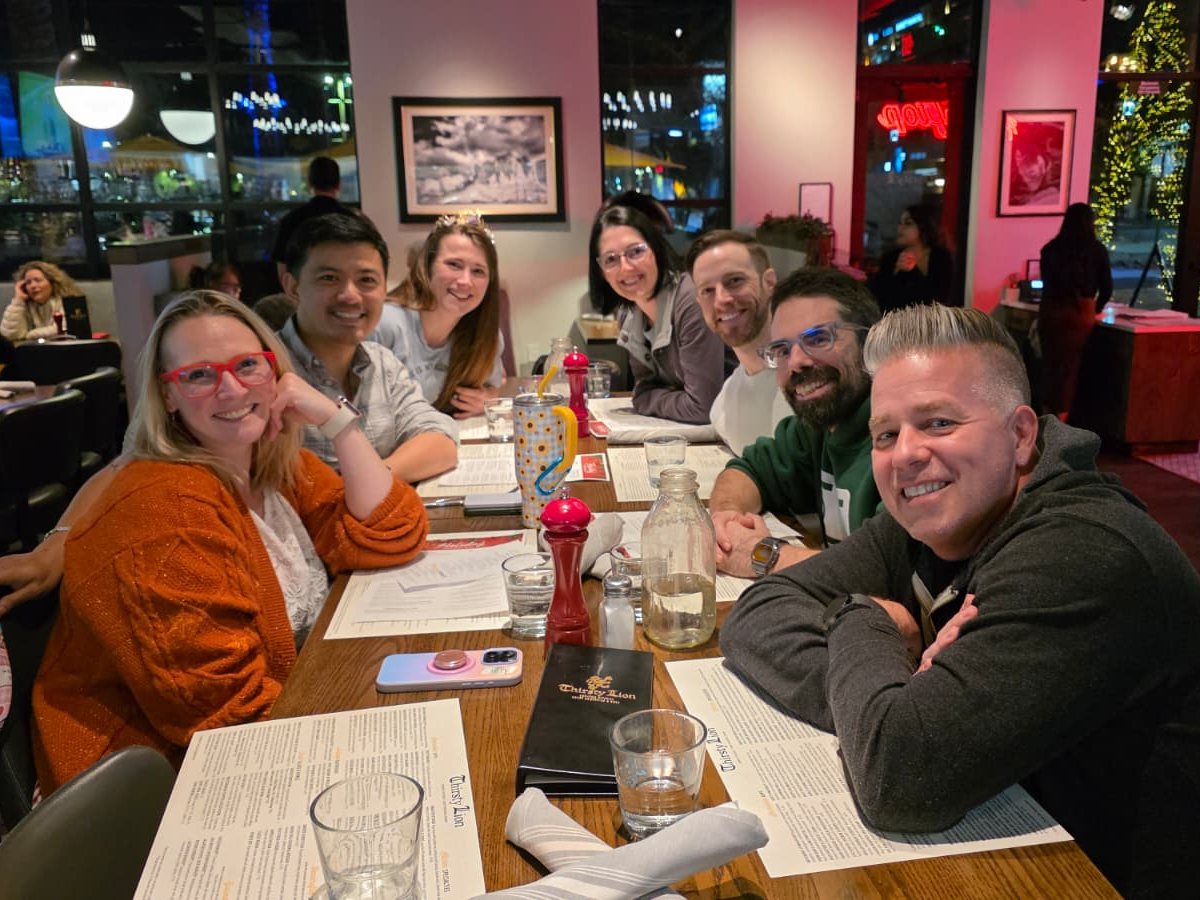
Pods of ten, max. Assigned by hand so the mix works. No pitching, no lurking, no one coasting on someone else's momentum.
Together we go further.
The outcome
Not a certificate and a folder of recordings. A finished thing, and the operating system that finished it.
Your commitment
The hire made. The offer launched. The system built. Whatever you named on day one, sitting finished behind you instead of ahead of you.
Your plan
North star, pillars, initiatives, 90-day commitments, weekly tasks. The hierarchy that connects what you want in five years to what you do on Thursday.
Your dashboard
A private workspace where your commitment, your week, and your progress live. Yours to keep after the cohort ends.
Your rhythm
A planning ritual, a reporting ritual, a review ritual. Simple enough to survive a bad month, which is the only test that matters.
Your room
Not a Facebook group of strangers. Nine owners who've heard your plan every week for a quarter and will still pick up the phone in year three.
Your scorecard
A record of what you committed to, what shipped, and what didn't. You'll know exactly where your execution breaks, which is the only way to fix it.
The dashboard
Your north star, your 90-day commitment, this week's tasks, and where the group can see you're stuck. No spreadsheet archaeology on Sunday night, and no seventeen-tab productivity system you built instead of doing the actual work. We say that with love.
Update it Monday. Report it Tuesday. That's the whole ritual.
Powered by a partnership with Aspen Strategy Collective
Aspen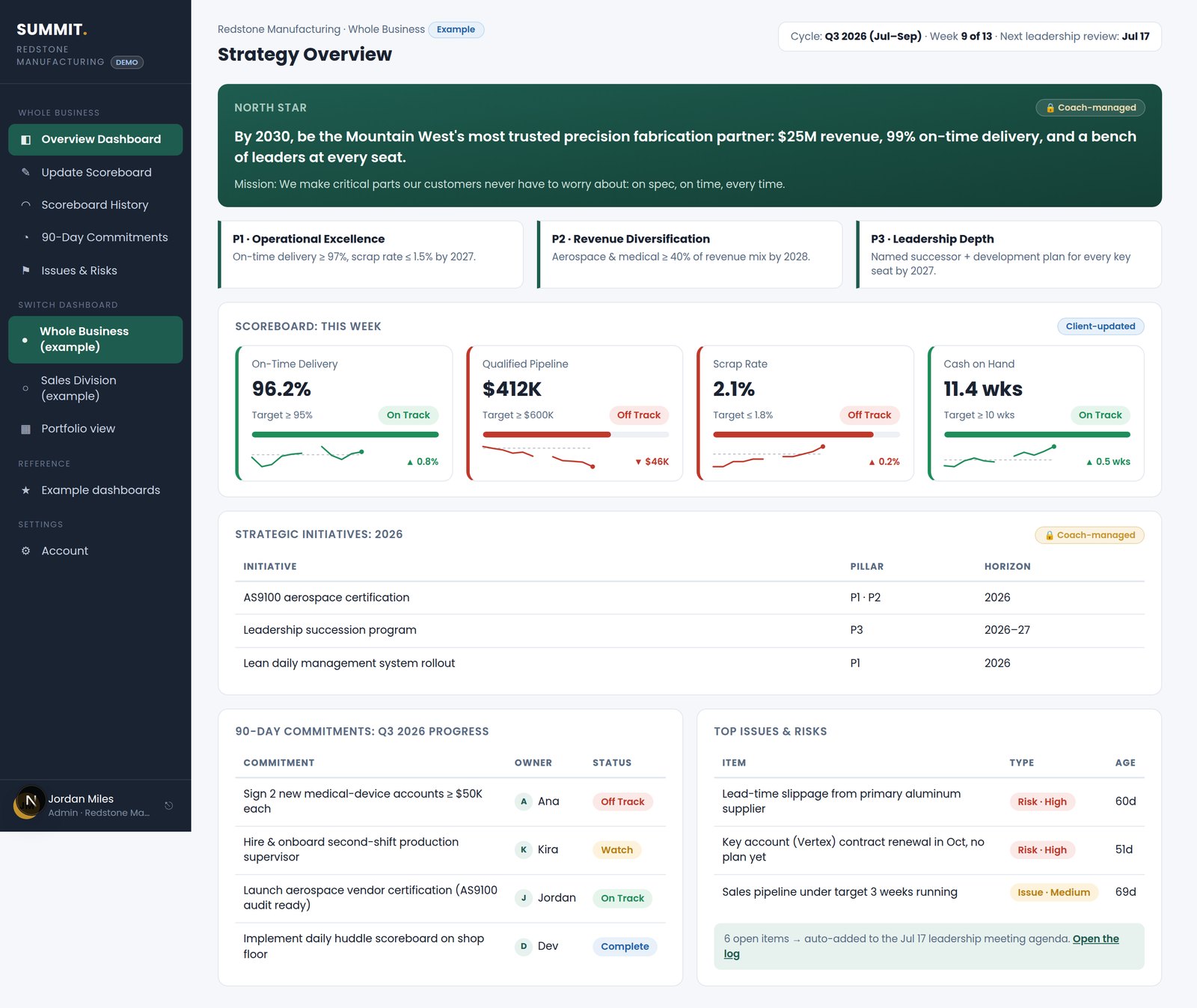
How the 90 days work
After that, the quarter is about execution and the weekly report. There's no curriculum to keep up with, because there's no curriculum.
Before kickoff
Grab your seat, then complete a short intake: where the business is, what's been stuck, and what you'd want to be true in ninety days. We build the cohort mix deliberately, so your pod isn't ten people with the same problem.
Day one
Three hours, together, live. You leave with one written 90-day commitment, the handful of moves that get you there, the first two weeks mapped, and your dashboard set up. Nobody leaves that session with a vague intention.
Your pod
You're assigned by hand to a pod of ten, mixed deliberately so you're not sitting with nine people who have your exact problem. The pod is your room. The cohort is your network.
Every Tuesday runs the same shape. Five minutes together in the main room. Thirty minutes in your pod, where every person answers what they said they'd do and whether they did it. Then back to the main room for one hot seat, worked live for someone in the cohort.
The main room is recorded and posted the same day. Pods are never recorded. Miss a call and you get the main room, not your pod's round, and that's deliberate: the unrecorded part is the part that works.
Every Tuesday
Same opening question every week: what did you say you'd do, and did you do it. Then one hot seat, where the room works a real problem for someone. Recorded and posted, so missing one doesn't put you behind.
Between calls
Stuck at 9pm on a Tuesday, post it. You'll have answers from people who've had the same problem before the next call. Your dashboard updates as you go, so Tuesday's report writes itself.
Day ninety
You review the cycle honestly: what shipped, what slipped, what you learned about how you actually work. Then you set the next 90-day commitment before you leave. Nobody restarts from zero, which is the whole point of running in cycles.
Tuesdays, 10:00–11:00 AM PT / 1:00–2:00 PM ET · the cohort runs Sep 16 to mid-December
Enrollment closes Sunday, September 13 · 12 VIP spots
What's included
Wednesday September 16, three hours, 11 AM to 2 PM PT / 2 to 5 PM ET, facilitated by both of us. Your 90-day commitment — the one that changes your year, not the one that's easy to say — gets written and pressure-tested by your pod before you commit to it.
Sixty minutes every Tuesday from kickoff to day ninety. Main room, then your pod, then one hot seat. Main room recorded and posted the same day.
A workspace built on the Summit Portal by Aspen Strategy Collective: north star, pillars, initiatives, 90-day commitment, weekly tasks. Set up on day one, and your plan and history stay in your account.
Async access to the room and to both facilitators. Post a problem, get real answers from operators, not from a bot or a comment section.
The five-dimension readiness model and the planning hierarchy behind it, licensed from Aspen Strategy Collective. Not taught as a course, used as a working tool on your actual situation.
Your plan, your history, and your scorecard stay in your account whether or not you run another cycle. Community access continues afterward as an optional low-cost monthly membership, so the room's still there if you want it.
Founding cohort
Core is the full GSD experience. You'll build your 90-day plan, track it in your dashboard, meet with your pod every Tuesday, and have access to both of us between calls.
VIP is for people who want us closer to the work. You get everything in Core, plus more direct access, more opportunities for coaching, and more of our eyes on your business throughout the 90 days.
Want the structure and accountability? Core has you covered.
Want more of us in the weeds with you? That's VIP.
$497 $999One time, or three payments of $197.
Ninety days includes:
12 spots
$1,497 $2,999One time. Twelve spots.
Everything in Core, plus:
How it compares
Most 90-day rooms start at $3,000. Founding members get in at a fraction of the cost and keep it as long as they stay. Only this cohort is priced this way, and it closes September 13.
Enrollment closes Sunday, September 13 · 12 VIP spots
After the ninety days
We'd love to have you run a second cycle and lock in your founding member rate for as long as you still like us!
Who it's for
Pods of ten, and a room that only works if the mix is right. Worth being straight about whether this is your quarter.
Real people.
Real work.
Questions
No. The work is your actual business. We have absolutely no desire to give a busy business owner a fake assignment so they can feel behind in two places at once.
Update your dashboard Monday. Show up Tuesday. Do the work you said mattered. That's it.
Full refund any time before the kickoff workshop, no questions asked. After kickoff we handle genuine extenuating circumstances case by case, and we're reasonable about it.
We're strict about this for a reason that isn't money: your pod is assembled by hand, around you. Someone leaving in week six costs nine other people a seat they can't refill. If you're not sure you can commit to the ninety days, come to the next cohort instead.
Grab your seat
One time, all in. The planning session, twelve weekly calls, your pod, your private dashboard, the thread with both of us, and your day-90 scorecard.
Enrollment closes Sunday, September 13 · 12 VIP spots
The founding price is a case-study price. In exchange, you agree to share an honest testimonial and your before-and-after on the commitment you set.
The waitlist
We're finishing the last of the setup. Leave your name and we'll send your enrollment link the moment it's live — waitlist first, before anything goes out publicly.
$497 Core, $1,497 VIP. Founding rates, held for everyone on this list. You're not charged anything here.
Kickoff Wednesday, September 16 · 12 VIP spots